AI has made modernization non-negotiable


Subscribe to our newsletter
Get insights to help move your business forward.
In new research from Modus Create, 550 product and technology leaders share how AI is reshaping product development as it moves from experimentation to deeper integration. This shift is forcing organizations to confront legacy infrastructure with renewed urgency. Legacy system modernization is no longer optional. It’s overdue. AI doesn’t scale without a modern foundation.
Legacy system modernization is no longer optional
Legacy system modernization has long been on the roadmap for technology leaders. But today, the urgency looks different. AI is no longer a future initiative. It is a present operational demand. And it is exposing infrastructure gaps faster than many organizations anticipated.
Previously, nearly two-thirds of enterprises planned to modernize their legacy infrastructure. That number has jumped to a staggering 95%. And the force behind this shift is the same that’s shaping most technology decisions today. While cost reduction and compliance remain important drivers, AI has made modernization urgent across nearly every industry.
AI exposes the limitations of outdated infrastructure faster than anything before it. And if those limitations aren’t fixed, AI initiatives stall. The research makes one thing clear: AI doesn’t change your fundamentals. It forces you to fix them. Technical debt, rigid codebases, and fragmented architectures that some organizations once learned to ignore (rather unwisely) now directly constrain their AI ambitions. This realization is pushing even the most conservative enterprises to modernize their systems with renewed urgency.
In 2023, 67% of enterprises planned to modernize their legacy infrastructure. That number has jumped to 95%.
Cloud migration remains a modernization gateway
Cloud migration might feel like an old conversation to many experienced product leaders. Dismissing it now would be a mistake. In practice, it remains one of the most critical application modernization strategies, with 54% of organizations moving applications to newer cloud-based infrastructure.
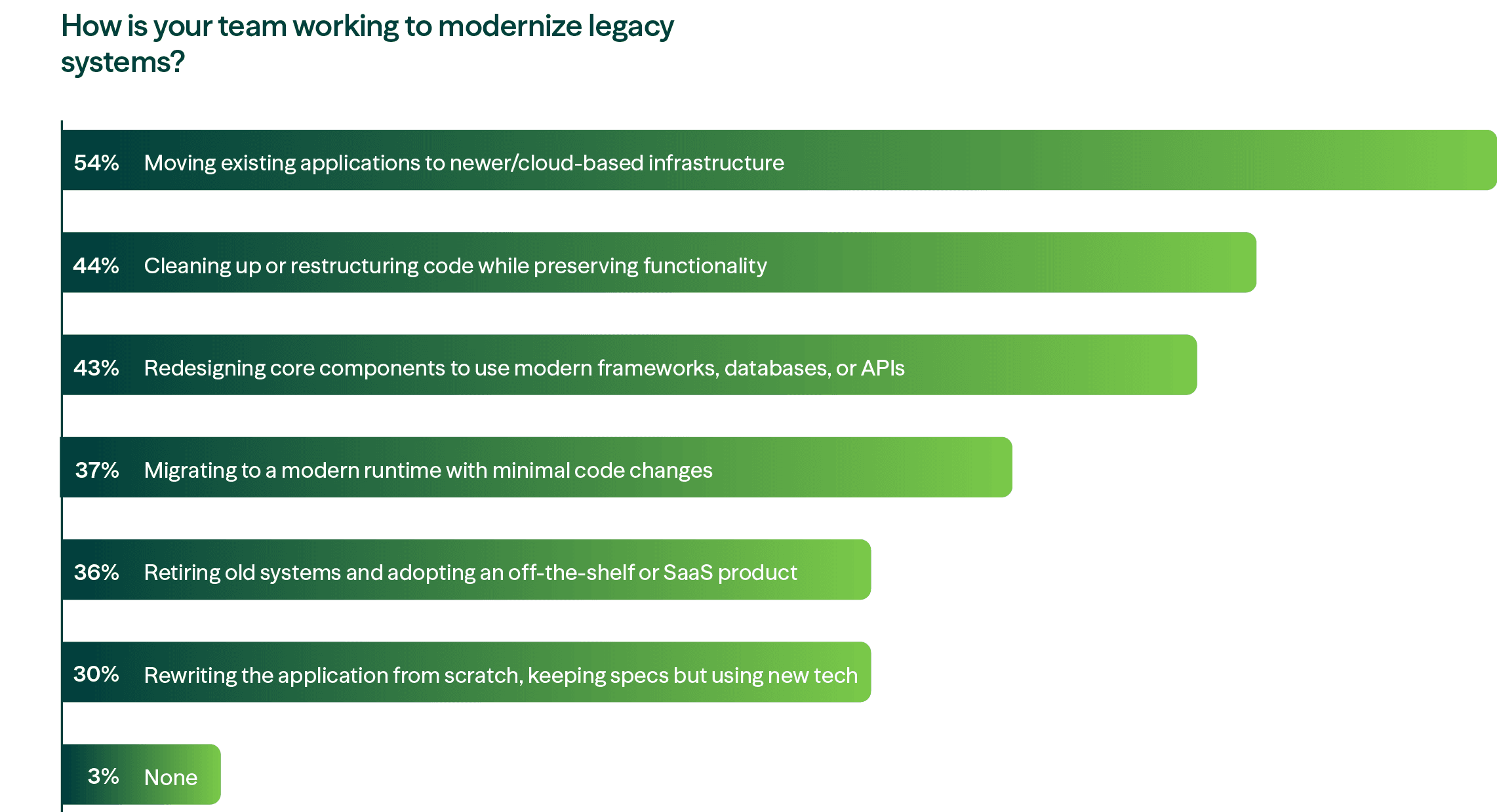
Cloud migration has regained urgency because it directly enables what AI needs to work at scale: on-demand computing power, centralized and accessible data, flexible application architectures, and systems that allow models to be deployed quickly into real-world workflows.
Cloud migration isn’t the end goal. It’s what makes real legacy system modernization possible. After cloud migration, organizations can redesign services, upgrade runtimes, and replace legacy systems in a structured and scalable way. Without this foundational move, every AI initiative is limited by the slowest and most fragile part of the technology stack.
This article might interest you: What is cloud modernization? An engineering guide to getting the decision right
Even regulated industries are moving to the cloud
High-integrity industries such as finance, life sciences, and manufacturing once favored on-prem data centers over the cloud. Hosting applications on-prem provided them with greater control over security, data governance, and privacy, areas often subject to strict regulatory oversight.
However, as cloud platforms have matured with several features specifically for highly regulated industries (advanced encryption, granular identity controls, sovereign environments, etc.), they inspire greater trust than ever before. At the same time, the need for unified, AI-ready infrastructure has made cloud migration the default entry point for legacy system modernization. That’s why cloud migration is the leading modernization move across high-integrity industries such as healthcare (50%), manufacturing (54%), and finance (53%).
There are interesting differences in the motivations across industries. Healthcare organizations modernize primarily to reduce friction in complex, regulated environments, focusing on system integration (52%), operational cost reduction (47%), and improved employee experience (43%). Manufacturing teams prioritize scalability, performance (46%), and efficiency gains at scale, alongside cost reduction and AI enablement (44%). Together, these differences highlight that modernization priorities vary widely across industries rather than following a one-size-fits-all model.
System modernization urgency is driven from the top
Historically, most legacy system modernization projects started from the ground up. Engineering teams identified mounting technical debt, performance bottlenecks, or security risks and advocated for modernizing infrastructure. The current wave of modernization, however, looks different. The urgency is now being driven primarily from the top, with executive leadership treating modernization as a strategic priority rather than a technical challenge.
65% of senior executives now consider legacy modernization a high organizational priority, compared with 51% of VPs and directors and just 32% of managers. From an executive perspective, the limits of legacy systems are hard to ignore:
- limiting scalability
- complicating compliance
- restricting access to data
- slowing AI adoption
As a result, modernization initiatives suddenly have higher budgets and stronger stakeholder backing across industries.
65% of senior executives now consider legacy modernization a high organizational priority, compared with 51% of VPs and directors and just 32% of managers
AI strategy always leads back to legacy system modernization
If your AI strategy doesn’t lead back to legacy system modernization, it’s not a strategy. It’s a wish list. AI strategy conversations quickly turn into discussions about architecture, data access, governance, and system readiness. While the research highlights pressures around ROI and AI maturity, the organizations moving fastest are the ones modernizing the foundations beneath their platforms.
Cloud migration continues to matter because it determines how quickly new services can be launched, how easily systems connect, and how reliably AI initiatives move from experimentation into production. Teams that treat cloud migration as an ongoing modernization program (retiring legacy components, modernizing runtimes, and consolidating data platforms) consistently reduce delivery friction and improve execution speed. Over time, these improvements add up, helping product teams release faster, scale with fewer disruptions, and turn AI into real business impact.
Cloud migration is often the first step. But sustained AI advantage comes from viewing legacy system modernization as ongoing work, not a one-time project you check off and forget.
See the findings from our latest report, AI in product development: A reality check, a comprehensive study of how 550 product and technology leaders are actually deploying AI in their organizations.

More insights from our research
This article is part of a series of findings from AI in product development: A reality check, Modus Create's study of 550 product and technology leaders. Explore the other articles in the series:
- Rushing AI, missing ROI: What's slowing product innovation
- AI maturity mirage: What leaders believe vs. what teams see
- AI is widening the product strategy/delivery divide
- Shift governance left or slow AI down
- Pressure to prove ROI is rising
- AI is reshaping product teams, not shrinking them
- AI build vs. buy decisions are often driven by the wrong factors
Modus Create is a digital product engineering partner for forward-thinking businesses. Our global teams work side-by-side with clients to design, build, and scale custom solutions that achieve real results and lasting change.
Related Posts
Discover more insights from our blog.


