AI is reshaping product teams, not shrinking them


Subscribe to our newsletter
Get insights to help move your business forward.
In new research from Modus Create, 550 product and technology leaders share how AI is reshaping product teams as it moves deeper into the product lifecycle. The findings show that teams are evolving toward hybrid roles, broader technical fluency, and closer integration with external expertise. Read the full report on AI in product development -->
The “AI will take our jobs” narrative might give you the impression that product teams are shrinking. And while teams are getting leaner, that doesn’t always mean fewer people.
Our latest research shows that 91% of product teams are experiencing structural or hiring changes linked to AI. In most cases, this shift is driven less by reducing headcount and more by increasing talent density.
Reskilling & hiring are outpacing downsizing
53% of product teams are reskilling existing developers to work with AI tools, and 44% are consolidating roles into AI-augmented generalists. At the same time, 43% plan to hire more data scientists and ML engineers, while only 30% are looking to reduce traditional engineering headcount. This shift reflects a move toward higher capability per person, not fewer people overall.
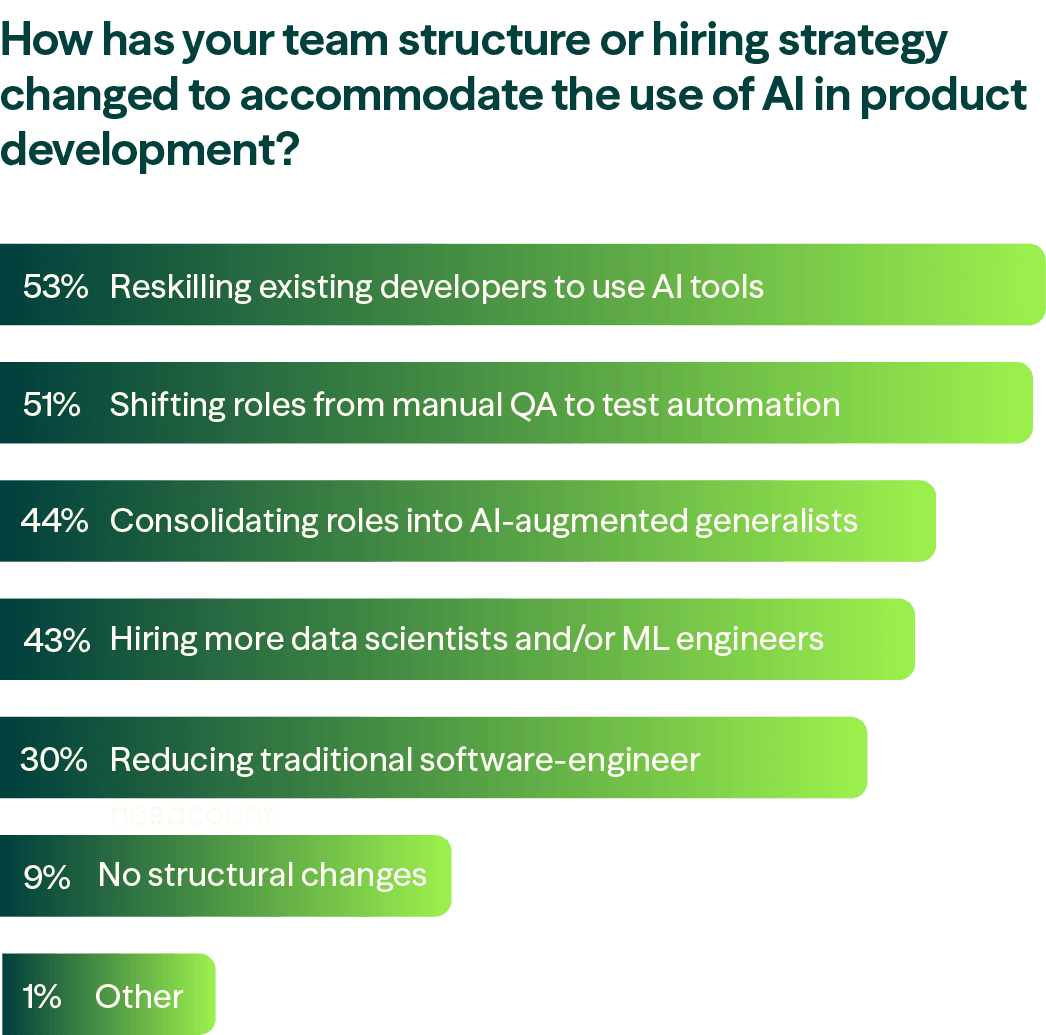
We are moving toward product teams where engineers are expected to work with prompts and agents, analysts are expected to model data, and product managers are expected to interpret outputs and understand system behavior. This is raising the floor of competence across the entire product function and blurring traditional role boundaries.
External expertise is becoming part of the operating model
You can tell a lot about a product team’s operating model by the kind of work it entrusts to external experts. As AI raises the bar for compliance and user expectations, organizations are turning to outside experts to fill gaps.
A significant majority (60%) of product teams now report that finding the right partner or consultant for new product initiatives is extremely important, up from 51% in 2023.
Security and compliance top the list of areas organizations are most likely to seek external support. Other top areas include system integration, AI/ML model development, and data infrastructure, which can eat up significant resources if executed entirely in-house. These are not edge capabilities. They sit at the core of modern product development.
Strategic and people-focused support is also in demand, with 23% seeking help with product strategy and team training, and another 21% looking externally for customer feedback and research.
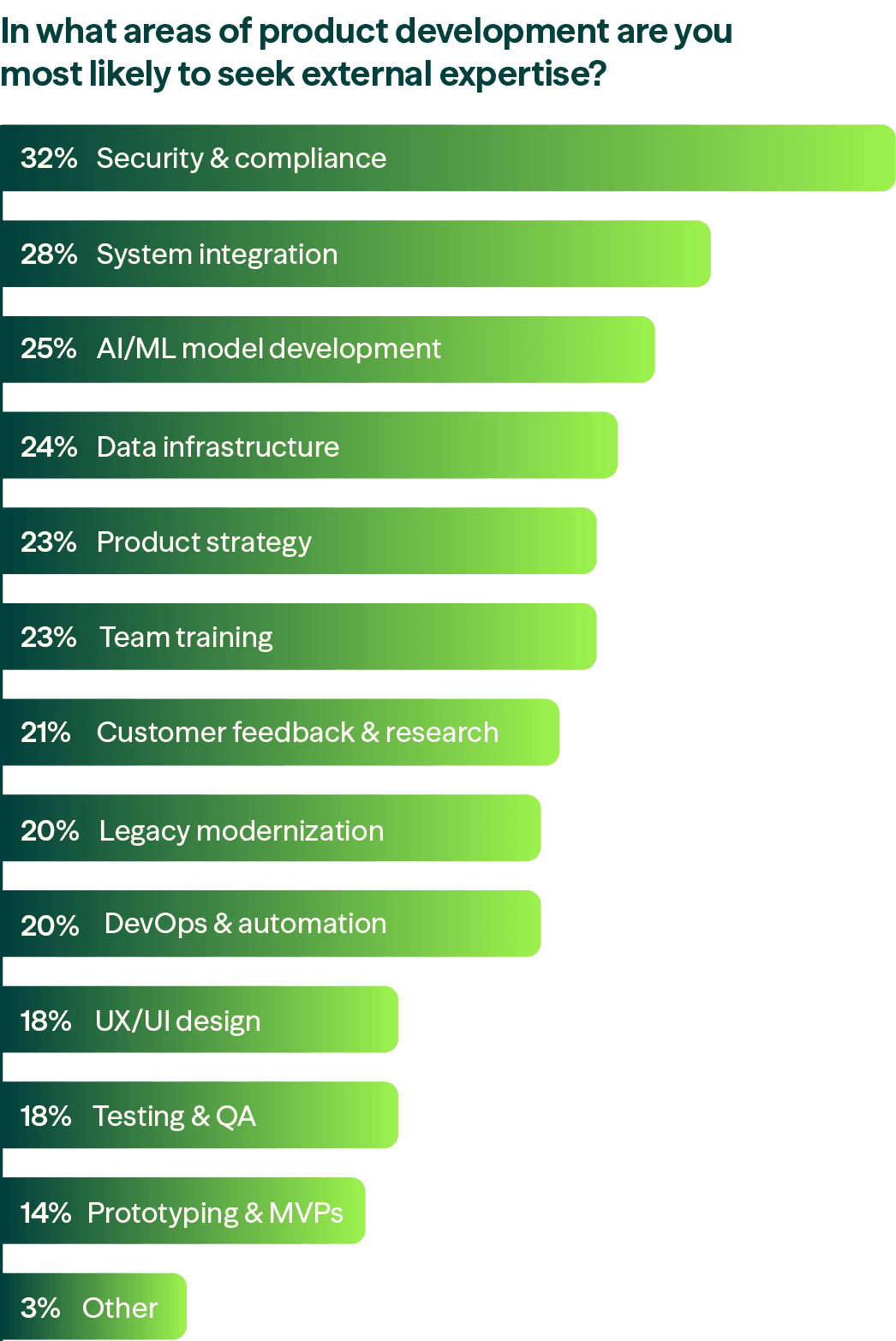
This points to a shift in how teams are structured. External expertise is no longer treated as support that sits outside the team. It is part of the operating model itself, shaping decisions alongside internal teams rather than being brought in after the fact.
AI is exposing where product teams break down
AI has removed the friction that once masked weak execution. When delivery cycles stretched over weeks or months, misalignment and unclear ownership showed up as delays. Now, those same issues surface almost immediately. This is why 75% of product leaders say executing product strategy is a major barrier to success for their organization. Leaders report difficulty creating efficient processes, scaling technology strategically, and aligning departments around shared goals.
“Vibe coding is like one big party. You move fast, everyone’s buzzing, and something flashy gets built overnight. But when the lights come on, there are half-empty cups, a broken chandelier, and the cleanup sucks.” — Kevin McClelland, Chief Growth Officer, Modus Create
On the other hand, AI acts as an amplifier for product teams with strong fundamentals. Clear priorities, strong ownership, and integrated systems allow speed to compound into progress, which helps teams see real ROI from their investments.
When speed is easy, alignment becomes your advantage
The challenge is no longer how fast teams can move, but how consistently they can move in the same direction. For years, product teams were built around speed. The “move fast, break things” mindset encouraged teams to ship quickly, test ideas, and decide just as quickly whether to roll back or push forward.
AI has changed how teams operate by making that speed widely accessible, compressing what once took weeks into cycles that now play out within days or even hours. This allows product teams to launch MVPs, learn from feedback, and improve products almost continuously.
But when speed is easy, real advantage shifts to alignment. Speed without alignment, after all, only increases the cost of misalignment.
“Teams shouldn’t rush to reduce headcount in the name of AI efficiency. Expertise is what makes AI valuable. Without professionals who understand how to build, govern, and apply AI effectively, outcomes quickly become unreliable, insecure, and full of unintended consequences.” — Jon Allegre, Chief Customer Officer, Modus Create
Product teams are being restructured around this new shift. As expectations rise, teams are placing greater value on both deep specialization and broader capability across roles.
The priority isn’t reducing headcount. It’s building teams with higher capability density. Reskill where it strengthens execution, hire where specialization matters, and maintain clear ownership to guide AI-driven work.
This blog features findings from our latest report, AI in product development: A reality check, a comprehensive study of how 550 product and technology leaders are actually deploying AI in their organizations. Access the full report on AI in product development →

More insights from our research
This article is part of a series of findings from AI in product development: A reality check, Modus Create's study of 550 product and technology leaders. Explore the other articles in the series:
- Rushing AI, missing ROI: What's slowing product innovation
- AI maturity mirage: What leaders believe vs. what teams see
- AI is widening the product strategy/delivery divide
- AI has made modernization non-negotiable
- Shift governance left or slow AI down
- Pressure to prove ROI is rising
- AI build vs. buy decisions are often driven by the wrong factors
Modus Create is a digital product engineering partner for forward-thinking businesses. Our global teams work side-by-side with clients to design, build, and scale custom solutions that achieve real results and lasting change.
Related Posts
Discover more insights from our blog.


