7 AI use cases driving real returns in life sciences


Subscribe to our newsletter
Get insights to help move your business forward.
AI in life sciences often evokes images of breakthrough drugs, new molecules, and autonomous diagnostic engines. While such breakthroughs are certainly on the horizon, most of the progress today is happening in more conventional parts of the industry. What we might call boring AI.
Boring AI might not grab headlines, but it delivers measurable improvements in operational efficiency. It’s tempting to apply AI wherever it seems technically possible or where its impact seems most dramatic, but the best use cases tend to combine high friction with low or moderate risk. These use cases keep experts firmly in control of the final decision and offer one of the fastest, safest paths to realizing value from AI.
How to identify AI use cases in life sciences
When teams ask us where they should apply AI, we find it useful to start with two questions:
- How much friction is there in the existing process?
- What happens when AI gets something wrong?
Plot those two variables against each other, and you get something like an operational AI matrix. Consider these three principles:
- Friction is relatively easy to spot: Look for workflows where your people spend too much time searching for information or repeating the same analysis. Saving somebody five minutes once is a demo, but removing three hours from something they do 10 times a month is an operating model.
- Risk requires more thought: We’re less interested in whether AI can make a mistake (of course it can and it will) than in what happens when it does. Can a researcher catch a bad literature recommendation? Can a clinical scientist review a generated document before it leaves the organization? These are the questions to keep in mind.
- Regulatory and data environments deserve equal attention: Before scaling any use case, map the compliance constraints and data governance requirements it operates under. Rather than just a legal consideration, it shapes what AI can touch, where outputs can travel, and how the system needs to be documented.
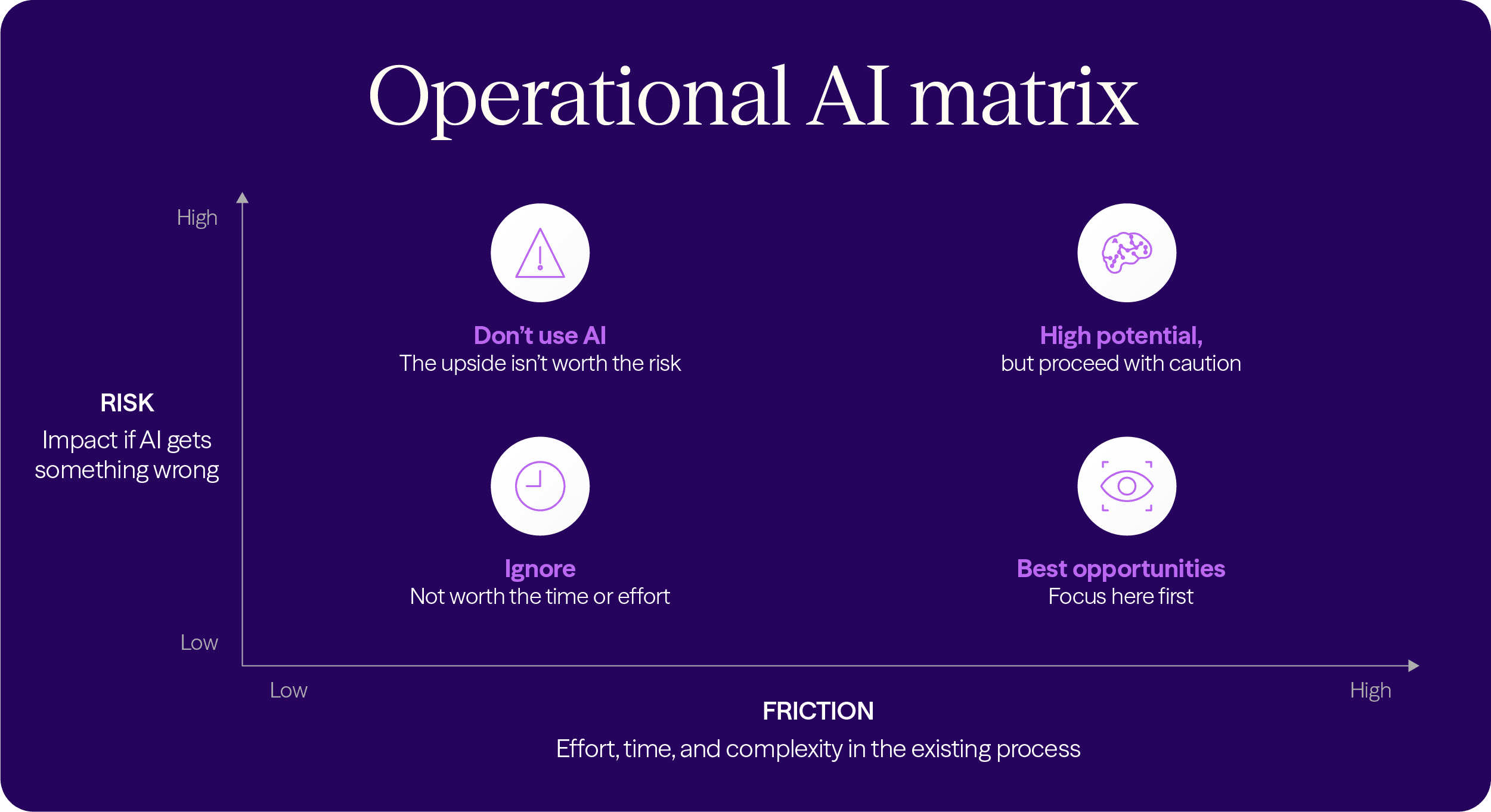
High friction with manageable risk is fertile ground for AI. High-friction, high-risk processes can still be valuable, but demand stronger validation and oversight. Low-friction processes rarely justify much investment.
One more thing we suggest asking before moving from a promising use case to a larger investment: How will you know it worked?
Start with a baseline. Before scaling the AI, measure the workflow you are trying to improve:
- How long does the workflow take today?
- How much manual effort does it require?
- How often does work get sent back for correction?
- What does an error cost?
- What level of human review is required?
Without those measures, a pilot can look impressive without providing much evidence that the underlying workflow improved. The same principle applies not only to life sciences operations, but also to the software delivery and validation processes that underpin them.
Where the returns are already showing up
Over the past few years, we’ve worked closely with some of the world’s largest healthcare and life sciences organizations to turn AI investments into measurable ROI. These seven use cases are some of the fastest ways to get enduring returns.
1. Scientific research & literature analysis
A scientific review can involve thousands of records before researchers reach the relatively small body of useful evidence. Because screening decisions need rigor and traceability, you cannot simply skim until something looks interesting. This is a use case that’s tailor-made for AI.
Machine learning and language models can help discover relevant literature, rank papers for review, screen titles and abstracts against inclusion criteria, and extract structured information from papers. Crucially, none of this requires handing scientific judgment to the model. So, while the machine reduces the haystack, the researcher still decides which needles matter.
The efficiency gains are already substantial. A 2025 review published in Frontiers in Pharmacology examined 25 studies evaluating AI-assisted automation in evidence synthesis. 17 reported time reductions greater than 50%, and some applications even reduced abstract-review time five- to six-fold.
Note that AI-assisted evidence synthesis is not the same as asking a chatbot what the literature says. That introduces exactly the provenance and reliability problems scientific teams worry about. A better design inserts AI into specific stages of an existing evidence workflow: retrieval, prioritization, screening, and extraction, while preserving, or even increasing, the importance of human review.
2. Clinical trial selection & patient recruitment
Even the simplest clinical trial involves a tremendous amount of information processing. Before enrolling a single patient, your team needs to answer questions such as:
- Where should we run the trial?
- Which sites should we select?
- How many patients can we realistically recruit?
- Which patients are actually eligible?
- What happens when the plan changes?
These questions involve analyzing large volumes of fragmented data, and then answering them all over again when any assumption changes. This is an expensive process, and every day a drug launch is delayed, pharmaceutical companies can lose nearly $500,000.
Of course, the answer isn't to rush the trial. The opportunity for AI is to accelerate the information processing around trial decisions while giving researchers more time to make them.
TrialGPT, developed by researchers from the U.S. National Library of Medicine and collaborators, identified more than 90% of relevant trials while searching less than 6% of the initial collection. In a pilot study, clinicians using it spent 42.6% less time screening patient-trial pairs, while retaining the final eligibility decision.
We’ve seen the same principle work in trial strategy. One global life sciences organization was manually combining enrollment patterns, site capacity, and political risk to build country strategies. We partnered with the company to build an application on Amazon Web Services (AWS) that combines predictive enrollment models with constraint optimization, allowing analysts to test scenarios in minutes rather than weeks. The result contributed to more than $5 million in cost savings.
3. Pharmacovigilance & safety reporting
On the surface, drug safety sounds like exactly the sort of high-risk function where organizations should tread carefully with AI. But treating the entire function as equally risky misses how the work is actually performed.
A pharmacovigilance operation contains plenty of judgment-intensive activity, but it also contains enormous amounts of structured, procedural work around it: processing cases, extracting information, preparing documentation, following up on missing information, and moving cases through standardized workflows. The trick, therefore, is choosing the right boundary.
Bayer France provides a useful example. Its pharmacovigilance team evaluated MyGenAssist, an internal LLM-based tool, for drafting case documentation letters. Rather than automating the underlying safety assessment, the system supported a repetitive documentation task within the workflow. Across the four-month study, the researchers reported an average of 23.3% time savings, without reducing the effectiveness of the task.
23% will never produce the same conference-slide excitement as an autonomous pharmacovigilance agent, but we would happily take that savings today over a flashy demo that struggles to make it to production.
4. Medical, Legal, & Regulatory (MLR) reviews
Consider what happens when a pharmaceutical company wants to publish promotional content. You need to:
- Identify claims and match them to approved evidence
- Locate all relevant references
- Check the language against regulatory and medical requirements
Additionally, as reviewers leave annotations and creative teams make corrections, a seemingly minor edit can send the content around the loop again.
All of this bureaucratic friction makes MLR a strong AI use case with high potential for returns. We saw this firsthand partnering with EVERSANA and AWS on its EVERSANA ORCHESTRATE™ MLR platform. It automated more than 90% of routine MLR tasks while reducing submission errors by 86% and costs by 35%. Content updates move through the process in hours or days, instead of weeks or months.
MLR is a favorable use case, with lots of structured evidence, repetitive comparison, explicit rules, and experts spending too much time on work that happens before the judgment they're actually paid to provide. AI can absorb much of that process burden without moving accountability away from the reviewer.

5. Quality engineering & software validation
Life sciences organizations depend on software across clinical operations, regulatory workflows, manufacturing, research, and commercial systems. Every change to those systems creates another question that must be answered before release: Did we test the right things, and do we have enough evidence to trust the change?
Much of the work required to answer that question is repetitive. Quality engineers review requirements for testability, determine coverage, build and maintain automation, investigate failures, and document the results. These activities require expertise, but every step doesn’t need to be performed manually.
We’ve built custom quality engineering agents to handle many of these tasks across the software development lifecycle. For example, specialist agents can:
- Analyze acceptance criteria and flag requirements that are too ambiguous to test
- Map requirements to the appropriate test coverage
- Investigate the application and existing test suite
- Generate automated tests, validate and execute them
- Automatically repair certain failures within defined limits
- Verify acceptance criteria and user interface behavior
- Triage failures and produce traceable coverage reports.
Rather than relying on one general-purpose agent to do everything, each agent has a specific job and passes structured evidence to the next step in the workflow.
Automation doesn’t remove quality engineers from the process. Humans are part of consequential actions, with stricter review and traceability as risk increases. Quality engineers still decide whether coverage is appropriate, what a failure truly means, and whether the evidence supports release.
That changes the economics of quality. Skilled quality engineers can spend less time creating artifacts and maintaining routine automation, and more on risk, exploratory testing, and release judgment. It also pushes quality upstream. Catching an untestable requirement before development is far cheaper than discovering it during validation.
6. Sales enablement
Life sciences sales teams are hardly starved for information. Quite the opposite. Between CRM histories, account data, clinical developments, case studies, battlecards, and approved content, most are swimming in it. The harder problem is getting the right piece of information to the right rep at precisely the moment it becomes useful.
AI can create a genuine commercial advantage here. Imagine a rep preparing to meet a prospect. Instead of hunting through CRM notes and content libraries, they receive a brief explaining what has changed since the last interaction and which approved materials are relevant. At the territory level, the same intelligence can help prioritize accounts. At the portfolio level, it can detect events worth acting on and trigger next-best actions.
This IQVIA case study offers a good example. During the launch of a novel antipsychotic, IQVIA helped a large pharmaceutical company use daily alerts to identify relevant clinical events and route them to field teams. Lead-to-engagement time fell from five weeks to 48 hours.
Five weeks to 48 hours is more than an efficiency gain. It changes the tempo of the entire sales process, allowing reps to act while a signal is still commercially relevant.
7. Pharmaceutical manufacturing process control & predictive maintenance
Pharmaceutical manufacturing moves us toward the more demanding end of the operational AI matrix. Pharma plants continuously generate process, quality, and equipment data. AI can use those signals in two valuable ways:
- Predictive process control identifies patterns that precede a deviation, giving teams a chance to adjust operating conditions before product quality is affected.
- Predictive maintenance catches equipment deterioration early enough to replace an emergency shutdown with planned maintenance.
Digital twins make both applications more powerful. By modeling how a production process behaves under different conditions, teams can train and test AI against a virtual process before putting it anywhere near a live one. FDA-affiliated researchers recently used this approach to train a neural-network controller for continuous pharmaceutical manufacturing, demonstrating better set-point tracking and better handling of process disturbances than conventional PID control.
However, this use case sits higher on the risk axis of our matrix because the consequences of getting it wrong are greater. A poor prediction could lead to unnecessary intervention or fail to flag a problem that affects product quality or puts a batch at risk. Human oversight can reduce that risk, but the consequences of an error are still considerably greater than in literature screening or sales enablement.

Look for the step before the expensive decision
You might have noticed one glaring pattern across all seven use cases we’ve discussed. AI tends to create value one step before the expensive decision.
| Use case | Where AI helps | Expensive decision |
|---|---|---|
| Scientific research & literature analysis | Finds, screens, prioritizes, and extracts relevant evidence | What the evidence means and how it should inform scientific decisions |
| Clinical trial selection & recruitment | Matches patient records against eligibility criteria and models enrollment scenarios | Who is eligible and how the trial should be designed and executed |
| Pharmacovigilance & safety reporting | Extracts case information, prepares documentation, and supports standardized workflows | How a potential safety issue should be assessed and handled |
| MLR review | Matches claims to evidence, checks references, and flags potential issues | Whether content is medically, legally, and regulatorily acceptable |
| Quality engineering & software validation | Analyzes requirements, generates and maintains tests, identifies coverage gaps, and triages failures | Whether the software has been adequately validated and is ready to release |
| Sales enablement | Connects commercial signals and surfaces relevant context | Who to engage, when to engage, and how to approach the interaction |
| Pharmaceutical manufacturing process control & predictive maintenance | Detects process drift and equipment deterioration | Whether and how to intervene in the production process |
That layer of work is everywhere in life sciences. It exists partly because the industry should be careful. Decades of strict regulation have created workflows where expert decisions are surrounded by enormous amounts of information processing. And that is where we suggest looking for AI returns.
Find decisions that are expensive to prepare for, then work backward. Look at what people have to search, reconcile, or monitor before they can make them. Not all those areas would be suitable for AI. But this is where the operational AI matrix can help you. Friction tells you how much value there is to recover, while risk tells you how carefully you need to draw the boundary around the model.
That boundary also aligns with how regulated industries think about accountability. Using AI to prepare information while keeping people responsible for the final decision means accountability and data boundaries are defined by design. In life sciences, that may ultimately matter more than the model you choose.
This friction-versus-risk lens extends well beyond the seven use cases we covered. We’re applying the same thinking to other challenges across life sciences. Explore our life sciences technology solutions ->
This article was developed with contributions from: Sean Clayton, Director, Security Engineering; Joel Gerbino, Director, Quality Engineering
Modus Create is a digital product engineering partner for forward-thinking businesses. Our global teams work side-by-side with clients to design, build, and scale custom solutions that achieve real results and lasting change.
LET'S GET STARTED
Talk to Modus Create
Big challenges need bold partners. Let’s talk about where you want to go — and start building the path to get there.
Related Posts
Discover more insights from our blog.