AI readiness assessment for regulated industries
A practical framework and checklist for assessing AI readiness in GxP environments
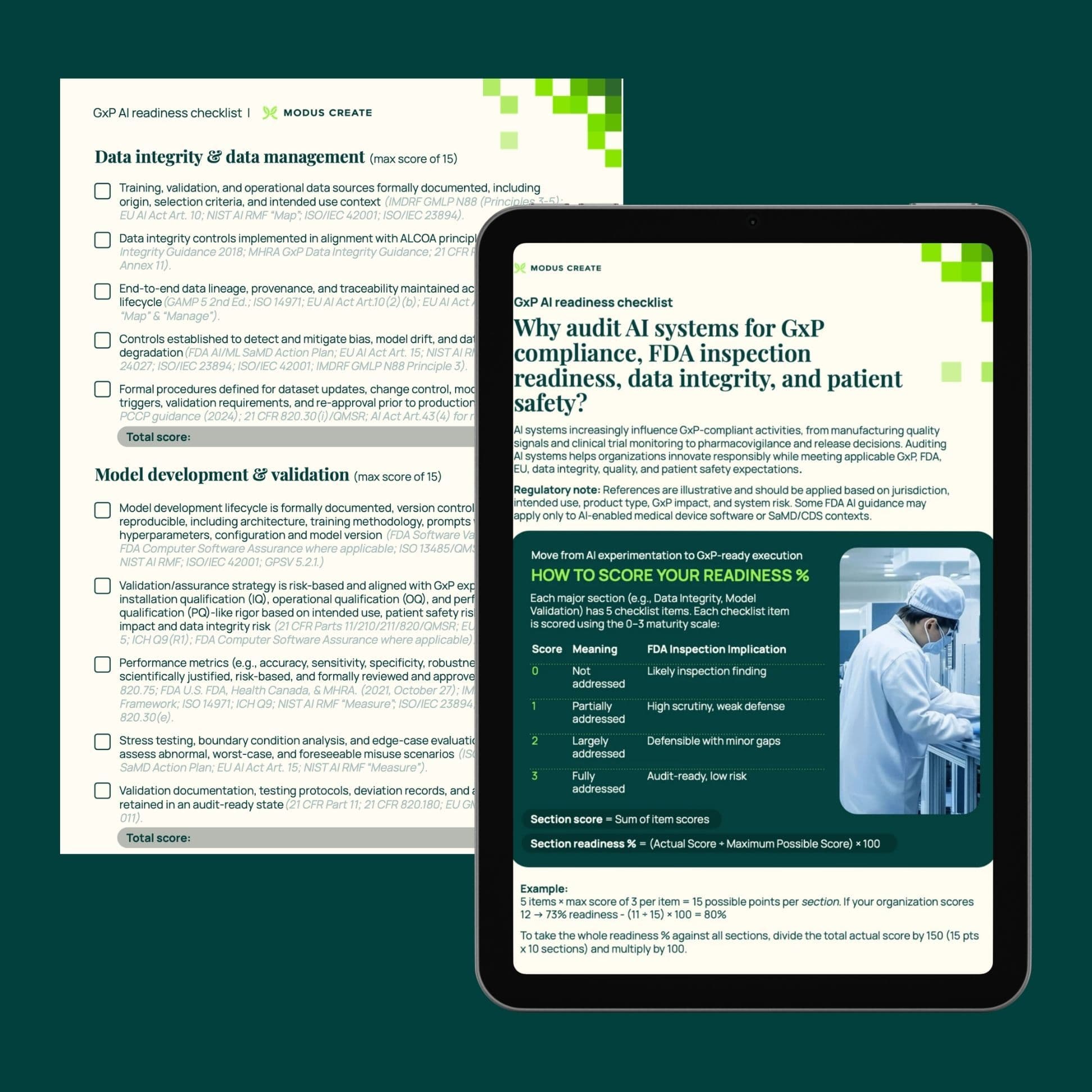
An AI readiness assessment helps organizations determine whether they have the governance, capabilities, and controls needed to deploy and scale AI responsibly in regulated environments. Use our AI readiness checklist to assess your current maturity, identify gaps, and prioritize next steps.
Free, practical assessment framework for pharmaceutical, biotech, medical device, diagnostics, healthcare, and other regulated organizations.
What is AI readiness?
AI readiness is an organization’s ability to develop, validate, deploy, operate, monitor, and retire AI systems in a controlled and sustainable way.
It goes beyond model performance. AI readiness means having the right people, processes, technology, governance, and controls in place to ensure that an AI system is fit for its intended use and can be managed throughout its lifecycle. Being AI-ready also means understanding potential risks, establishing appropriate oversight, and having the capabilities needed to move from experimentation to reliable, scalable deployment.
Why is AI readiness so important in GxP-regulated industries?
In GxP-regulated environments, AI systems can have a direct or indirect impact on product quality, patient safety, clinical decisions, manufacturing processes, and other regulated activities. This means organizations need to demonstrate that AI is not only effective, but also appropriately controlled and fit for its intended use.
The level of oversight required depends on the AI system’s intended use, GxP impact, risk profile, and regulatory context. An AI system supporting a low-risk internal activity may require a different level of control than one influencing a critical quality or clinical decision.
Why does AI require a readiness assessment?
AI systems introduce additional variables that can affect validation, change control, and ongoing oversight. Models, datasets, prompts, parameters, infrastructure, and third-party services can change over time, and performance can degrade in production. Generative AI can also produce outputs that are difficult to reproduce or interpret.
In regulated environments, an AI readiness assessment should cover:
Intended use
What is the system designed to do, and what GxP processes does it affect?
Risk
What could go wrong, and what is the potential impact?
Performance
Can we demonstrate that the system performs as intended?
Change control
Can we control changes to the model, data, prompts, infrastructure, and dependencies?
Monitoring
Can we detect performance degradation or unexpected behavior?
Oversight
Can we demonstrate appropriate controls and accountability during an audit or inspection?
Assess your AI readiness
Use our practical GxP AI readiness checklist to evaluate your current capabilities, identify potential gaps, and understand what may need to be strengthened before deploying or scaling AI in a regulated environment.
What does an AI readiness assessment cover?
Our AI readiness framework for GxP organizations covers ten critical areas, from regulatory alignment and risk classification to data integrity, validation, security, and ongoing monitoring.

1. Regulatory alignment & governance
AI needs to fit within your existing GxP and quality framework. This means understanding the applicable requirements, establishing clear ownership, and defining accountability for AI throughout its lifecycle.
2. Intended use & risk classification
Start with what the AI is actually being used for. Its intended use, GxP impact, potential effect on patient safety and data integrity, and overall risk profile should determine the level of oversight and control required.

3. Data integrity & data management
AI is only as reliable as the data behind it. This area looks at how data is sourced, transformed, documented, governed, and maintained, with the traceability and integrity required for regulated use.
4. Model development & validation
Validation should reflect how the AI system is used and the risks it presents. This includes a controlled and reproducible development process, appropriate documentation, and sufficient evidence to demonstrate that the system performs as intended.

5. Explainability & transparency
People need to understand what an AI system can and cannot be relied on to do. This includes documenting known limitations and failure modes, understanding how outputs should be interpreted, and defining when human judgment is required.
6. Change control & model lifecycle management
AI systems can evolve over time. Models, datasets, prompts, infrastructure, and third party components may all change. Effective lifecycle management means controlling those changes and determining when testing, review, or revalidation is needed.

7. System security & access control
The environment supporting an AI system needs to be well controlled. This includes access controls, audit trails, segregation of duties, and security measures across AI platforms, infrastructure, APIs, and third party services.
8. Documentation & audit readiness
AI systems need an evidence trail that can stand up to scrutiny. Documentation should demonstrate how the system was designed, assessed, validated, operated, monitored, and changed throughout its lifecycle.

9. Operational monitoring & continuous improvement
Validation is not the finish line. Once an AI system is in production, organizations need to monitor performance, detect unexpected behavior or emerging risks, manage incidents, and respond as the system and its operating environment evolve.
10. Organizational readiness & skills
AI adoption depends on people as much as technology. Teams need clear ownership, the right expertise and training, effective governance, and the ability to work across Quality, Regulatory, IT, Data Science, and Product.
Download the GxP AI readiness checklist
Use the complete checklist to assess your AI systems across the 10 areas covered in this guide. The checklist can help your Quality, Regulatory, IT, Data Science, and Product teams establish a common view of your current AI readiness and identify areas that may require further attention.
Frequently Asked Questions
When should you perform a GxP AI readiness assessment?
An assessment can be performed before deploying an AI system, moving an experiment into production, beginning validation, making significant model or data changes, adopting a third-party AI service, or preparing for an audit or regulatory inspection.
What does an AI readiness assessment deliver?
An AI readiness assessment provides a clear view of an organization’s current AI maturity, identifies key gaps and risks, and helps prioritize the actions needed to move toward safe, compliant deployment. Depending on the scope, the assessment may include a current-state evaluation, gap analysis, prioritized recommendations, and a practical roadmap with clear next steps.
What is an AI readiness framework?
An AI readiness framework is a structured approach for evaluating whether an organization has the capabilities, governance, processes, technology, and controls required to deploy and manage AI responsibly. In regulated environments, an AI readiness framework can help organizations assess areas such as intended use, risk, data integrity, validation, security, change control, monitoring, and human oversight.
Which regulatory frameworks should you consider for GxP AI readiness?
There is no single regulation that defines GxP AI readiness for every organization or use case. Depending on the context, organizations may need to consider requirements and guidance including FDA regulations and AI guidance, 21 CFR Part 11, 21 CFR Parts 210/211 and 820/QMSR, EU GMP Annex 11, the EU AI Act, GAMP 5, ICH Q9, ICH Q10, ISO 13485, ISO 14971, ISO/IEC 42001, ISO/IEC 23894, NIST AI RMF, and applicable data integrity guidance.
These frameworks should not be treated as a universal checklist of requirements. Applicability depends on the jurisdiction, intended use, product type, GxP impact, AI system classification, and risk profile.
About Modus Create
Modus Create brings together AI, software engineering, product, and regulated-industry expertise to help organizations move from AI experimentation to controlled production. Our teams assess AI readiness, identify technical and governance gaps, define the controls required for each use case, and build a practical roadmap toward deployment.
Explore more AI insights for life sciences
Use left and right arrow keys to navigate resource cards, or swipe on touch devices.