Planning your modernization roadmap? Find the gaps that could slow you down with our 5-minute assessment.
The AI bottleneck isn't coding. It's everything after it.


Subscribe to our newsletter
Get insights to help move your business forward.
Production is where AI loses momentum
In the last couple of decades, organizations have treated speed as the central engineering problem. When "move fast and break things" became mainstream wisdom, Agile understandably became the dominant philosophy of the day.
Velocity in code production used to be the limiting factor in software delivery. Teams hired more engineers, bought better tools, and invested in training. But AI has made writing code so fast that shipping speed has become almost irrelevant.
The paradox of acceleration
Our recent research on AI in product development found that 78% of organizations delivered more than three major product releases in 12 months. 33% delivered more than six.
As the pace of delivery increases, the gap between strategy and execution is widening too. 75% of product leaders say executing product strategy is a major barrier to success. Teams are running fast, but not always in the same direction.
The data confirms what many leaders already sense: speed and stability are pulling apart, not moving together. Faros’ research across 10,000 developers found that teams with high AI adoption completed 21% more tasks and merged 98% more pull requests. But bugs per developer increased 9%, while PR review time increased 91%.
Google's own research on AI-assisted delivery found the same conclusion: AI adoption now correlates with faster output, but systems are also becoming less stable. Teams have adapted to move faster, but the safety net underneath them hasn't caught up.
AI adoption now correlates with faster output, but systems are also becoming less stable.
Five new bottlenecks in product development
If shipping faster is no longer the advantage it once was, what should teams optimize for instead? Five bottlenecks are absorbing the pressure AI has created.
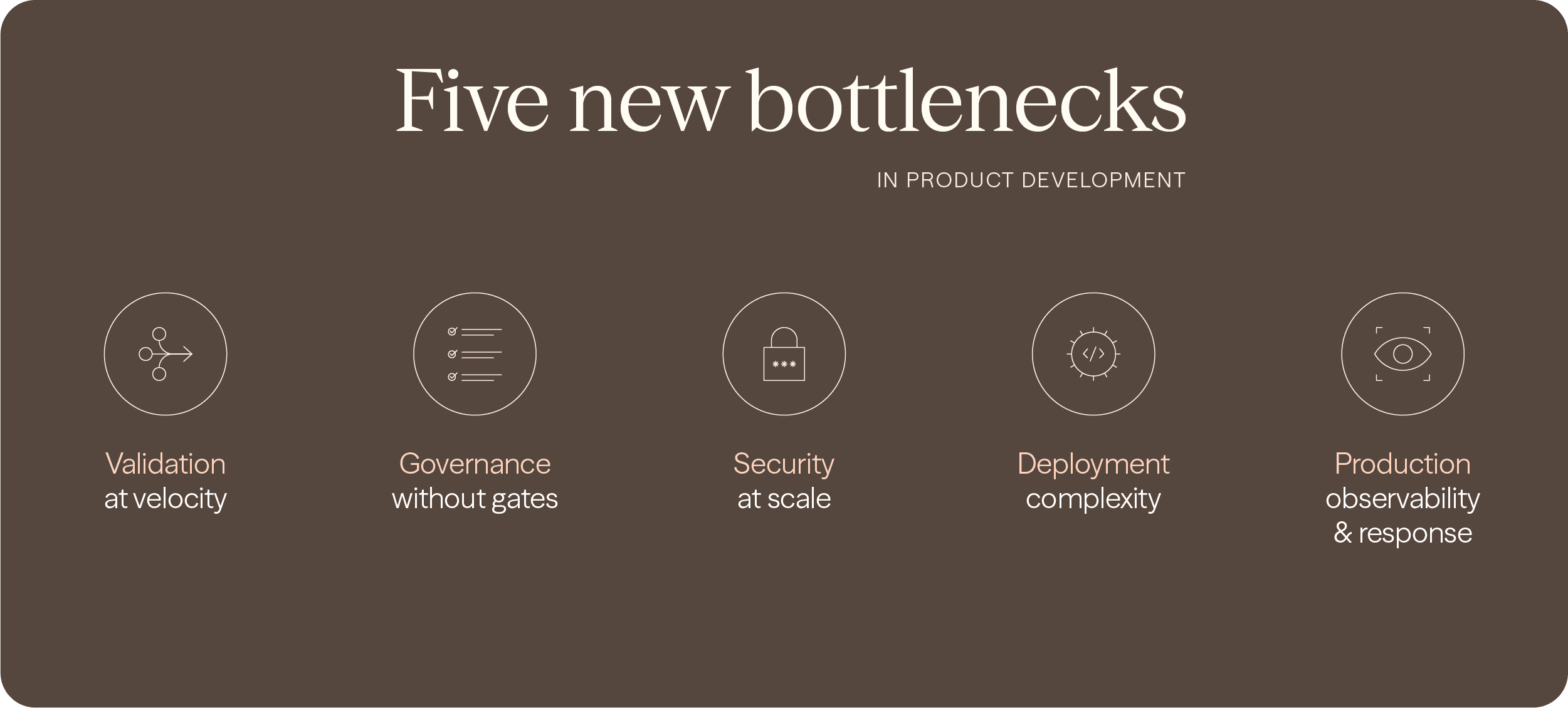
1. Validation at velocity
Before AI, the workflow was simple: build the feature, test the feature, and do so at roughly the same pace. Now teams are producing far more code than they can carefully check, so quality quietly declines even as output accelerates.
GitLab's 2026 survey of 1,528 developers confirms this directly: 78% say developers are writing and committing code faster since adopting AI tools, but 85% say AI has shifted the bottleneck from writing code to reviewing and validating it. The bottleneck has moved to later stages, into review and testing, where it's more expensive and harder to catch.
Teams that prevent this bottleneck build a habit of defining what "correct" looks like before building the feature — writing down the expected behavior first, then confirming afterward that the result actually matches it, not just that it runs without errors. Teams that skip this step often end up validating that their code executes without ever confirming it does what it's supposed to.
2. Governance without gates
Governance checkpoints — reviews, security scans, audit trails — were built for a much slower pace of work. They were already a bit of a bottleneck by design, and AI has multiplied the number of decisions flowing through them without changing how risky any single decision actually is.
Adding more reviewers doesn't fix this. Neither does removing the checks altogether. What works is building the rules directly into the process, so compliance and security are automatic by default instead of a later checkpoint. This doesn't remove human judgment. It frees people to spend their attention on the handful of decisions that actually need it.
Here is a useful gut-check. Look at the last 20 approvals your team gave on sensitive changes, and ask how many actually resulted in a change being made. If it's close to zero, that approval step is simply adding time without providing any benefits.
3. Security at scale
A peer-reviewed study of AI coding tools found that code complexity rose by roughly 39% after teams adopted them, and that this extra complexity persisted even after the initial speed gains faded. In plain terms: AI gives a burst of speed, but it can leave behind a system that's genuinely harder for humans to understand. And a system nobody fully understands is a system that's harder to keep secure.
AI gives a burst of speed, but it can leave behind a system that's genuinely harder for humans to understand.
The signal worth watching is when complexity is piling up in one place. Ask your engineering leads, once a month, which part of the product they'd least want to touch. If the same answer keeps coming up, that's where problems are quietly accumulating, and it needs attention before more features get added on top of it. Teams with a unified platform and security practices can run real-time guardrails that automatically flag risky patterns and suggest refactoring before they become liabilities.
This article might interest you: 11 DevSecOps best practices, in the right order
4. Deployment complexity
A team finishes a feature, it works in testing, and everything looks ready. That’s when they discover a piece of the product still depends on the old version, or that undoing the change if something goes wrong isn't actually possible.
Whether a team can move at AI speed safely depends on how well-prepared their systems are to absorb change — automated safety checks, gradual rollouts, and a reliable way to undo a change if something breaks. This is the core job of a strong platform team: making deployment a routine, well-rehearsed operation instead of a stressful, one-off event.
Here’s one effective test during planning. If no one can describe how a change will be rolled out in two or three plain sentences, the work usually isn't actually ready. It just looks ready.
5. Production observability & response
Most monitoring tools were built to answer one question: Is the system up and running? AI changes the questions that matter now:
- Which change caused this problem?
- Has this happened before?
- Is this a one-off, or an early warning sign of something bigger?
For AI-powered products specifically, this is even more important. EY's 2025 survey of 975 C-suite leaders found that 99% of organizations have already taken a financial hit tied to problems with their AI systems, averaging $4.4 million per affected company. Yet most organizations aren't watching their AI systems as closely as they watch the rest of their critical infrastructure.
Many organizations are running AI-powered products without any ongoing checks for whether the AI is giving wrong answers, drifting from expected behavior, or creating risk in the real world.
Let me share a simple practice. After your next incident, resist the urge to open a dashboard. Instead, write down every question your team asks in the first ten minutes. Those questions should define what your monitoring is built to answer.
Why point solutions don't work
The instinct at most organizations is reasonable on its face: checking is too slow, so add more testing. Security slows releases, so add another checkpoint. Deployments get shaky, so upgrade the tools.
Each decision makes sense on its own, but none of them solves the real problem, because speeding up one part of software delivery just shifts the pressure to the next one. AI exposed this by removing the slowest part of the process almost overnight.
Most organizations still run platform, quality, and security as three separate teams, each with its own tools and its own way of measuring success. Every handoff between them adds friction. And because the work is split three ways, no single team is actually accountable for the most important objective: getting products to customers faster and safer, together.
Want to understand whether your organization is actually ready to operate AI in production? Our AI readiness assessment framework helps identify gaps across validation, governance, security, monitoring, and organizational readiness.
Integrated teams beat faster teams
The companies overcoming these bottlenecks have one thing in common: they organize around production readiness. Instead of treating platform engineering, quality, and security as separate functions, they bring them together under shared ownership.
These teams spend less time chasing production issues because reliability, security, and quality are built into the delivery process from the start. They deploy with more confidence, respond to problems faster, and avoid many incidents altogether.
This shift is becoming less of a competitive advantage and more of a necessity. The organizations making it now are building systems that improve with every incident and automate safe deployments. They treat production as the benchmark for every engineering decision, not the place where defects are discovered.
Faster development only creates value when production can keep up. Learn how your organization can build faster, safer software delivery.
Michael Hodgdon is VP, Product Engineering Services at Modus Create, where he leads work on integrating security testing directly into software development lifecycles. With 25+ years of experience in technology leadership and consulting, he specializes in helping organizations modernize how they build and secure software—especially as AI agents become more prevalent. He's based in the Greater Boston area.
LET'S GET STARTED
Talk to Modus Create
Big challenges need bold partners. Let’s talk about where you want to go — and start building the path to get there.
Related Posts
Discover more insights from our blog.